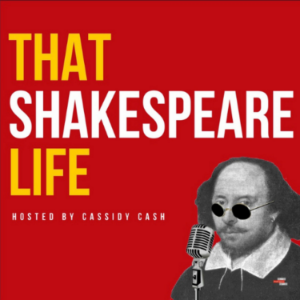
That Shakespeare Life
History Podcasts
Hosted by Cassidy Cash, That Shakespeare Life takes you behind the curtain and into the real life of William Shakespeare.
Location:
United States
Description:
Hosted by Cassidy Cash, That Shakespeare Life takes you behind the curtain and into the real life of William Shakespeare.
Twitter:
@thatshakespeare
Language:
English
Contact:
2057902617
Email:
cassidy@cassidycash.com
Episodes
Starlings in Shakespeare's England
4/20/2026
In Shakespeare's Henry IV, Part 1, Hotspur delivers a chilling threat against King Richard:
"I'll have a starling shall be taught to speak
Nothing but 'Mortimer,' and give it him
To keep his anger still in motion."
It's a line rooted in the politics of kingship and rebellion—but it also hinges on something strikingly practical. The idea of teaching a starling to speak wasn't poetic fancy. It was entirely possible. In fact, it was happening in Shakespeare's lifetime.
This week, we're stepping beyond the metaphor to explore the real bird behind the threat. What was the behavior, temperament, and reputation of the starling in early modern England? Were they truly trained to mimic speech? Were they kept as pets—or even raised for the table alongside other fowl?
Here to guide us into the world of the early modern starling is Lee Raye, author of Creatures of Story and Song: Tracing Britain's Lost Species. Lee's work traces the historical presence of wild animals and plants, and today, they help us uncover how fact and drama intersect in the history of one of the world's most fascinating birds.
Duration:00:23:06
Seige of Famagusta and Shakespeare's Othello
4/13/2026
In Shakespeare's Othello, the Second Senator in Act One warns of a Turkish fleet bearing down on Cyprus. Later in that same scene, the Duke of Venice remarks, "The Turk with a most mighty preparation makes for Cyprus. Othello, the fortitude of the place is best known to you."
References to Cyprus appear again and again throughout the dialogue—calling attention to wars, naval battles, and the conflicts surrounding the island, including, as Iago puts it, the struggle between "grounds Christian and heathen."
Shakespeare places Othello in Cyprus at a moment of extreme tension. In the play, the island has just faced an imminent invasion by the Ottoman Turks. The Venetian fleet is mobilized, generals are dispatched, and Cyprus is on high alert. It makes for an exciting story—but what's even more compelling is that the setting Shakespeare chose mirrors real history almost exactly.
In 1570 and 1571, Cyprus—then a Venetian possession—was attacked by the Ottoman Empire. The final and most famous stronghold was a city called Famagusta, whose siege became infamous across Europe.
For Shakespeare's audience, Cyprus under Turkish threat was not fictional—it was recent news. When Othello opens with fears of invasion, Shakespeare is tapping into a collective memory of terror and loss that was still emotionally raw.
To help us explore how the play connects to the real history Shakespeare's audience would have recognized immediately, I'm delighted to welcome our guest today, Michael Walsh.
Duration:00:30:43
Courts, Rackets, Balls, and Rules: The Game of Tennis in the 16th Century
4/6/2026
In Shakespeare's plays, we see 6 total references to tennis. Polonius mentions an argument over a tennis game in Hamlet. Henry V and Pericles talk about tennis courts and there's even a couple of references to "tennis balls" showing up in Shakespeare's other plays, talking about them being played with at the game of tennis, as well as being stuffed as part of the process of making a tennis ball. We can tell that Shakespeare and his contemporaries knew about the game of tennis, but where did it come from? How was it played? Do we know anything about these tennis courts they used? To find out more about the history of tennis from Shakespeare's lifetime, today we're talking with Laurence Grove. Laurence is a Professor of French and Text/Image Studies at the University of Glasgow, and was recently the guest expert for an article inside PBS's report into newly discovered images that reveal some interesting new findings about the 16th century history of tennis. Laurence joins us today to share these findings, as well as to explain what tennis would have been like for Shakespeare.
Duration:00:28:57
Easter in Shakespeare's England: Faith, Feasting, and a New Doublet
3/30/2026
Shakespeare's only reference to Easter comes up in Romeo and Juliet Act III when Mercutio talks about buying a new doublet for Easter. Despite only a single reference to this holiday, for the people of 16-17th century England, Easter was a major event. Holidays in Shakespeare's lifetime largely followed the life of Jesus Christ, and the resurrection of Jesus that is celebrated on Easter Sunday was a high point of the year's festivities. Here today to share with us the customs, foods, and yes, the clothing like a new doublet, that would have been staples for the observance of the Easter Holidays in Shakespeare's lifetime, is our guest, and author of Reformation England 1480-1642, Peter Marshall.
Duration:00:57:48
Monkeys and Apes in Shakespeare's England
3/23/2026
In this episode of That Shakespeare Life, we explore the surprising presence of monkeys, apes, and baboons in early modern England and the role these animals played in the culture of Shakespeare's world. Shakespeare refers to primates dozens of times in his plays, and those references were not purely imaginative—exotic animals were arriving in England through global trade, kept as fashionable pets by elites, and even trained to perform tricks for public entertainment. By examining travel narratives, natural history books like Edward Topsell's The History of Four-Footed Beasts, and records of animal performances near the London theatres, we uncover how early modern audiences understood these creatures and why primates became such vivid symbols in Renaissance literature and stage culture.
Duration:00:34:25
Children's Toys and Games in Tudor England:
3/16/2026
What toys did children play with in Shakespeare's lifetime? In this episode, historian Dr. Julia Martins joins That Shakespeare Life to explore the games, dolls, rattles, hobby horses, and playground activities that shaped childhood in Tudor England—and how these playful details appear in Shakespeare's world.
Duration:00:36:47
How HIstorians Know Shakespeare is Shakespeare
3/9/2026
Joined this week by historian Susan D. Amussen, we take a close look at the historical evidence that confirms William Shakespeare as a real working playwright and actor in early modern England. Drawing from Susan's book What's in a Name?, we explore the documentary records—from theater company memberships and tax records to property purchases—that trace Shakespeare's life from Stratford-upon-Avon to London's vibrant theatrical world.
We also compare the surviving evidence for Shakespeare with what we know about other playwrights like Christopher Marlowe, and discuss how historians interpret the gaps in the historical record. Along the way, Susan explains what the archives reveal about Shakespeare's work with the Lord Chamberlain's Men (later the King's Men) and how these records help historians answer the enduring question: how do we know Shakespeare is Shakespeare?
Duration:00:30:57
Ides of March in Renaissance England
3/2/2026
In this episode, we explore what the "Ides" actually meant in ancient Rome and how March 15th transformed from an ordinary—sometimes even festive—date on the Roman calendar into one of history's most infamous days. Jörg Rüpke explains how Romans understood their calendar, what rituals or superstitions may (or may not) have surrounded the Ides, and how news of Caesar's assassination would have spread through the city. We also examine the differences between ancient historical sources and Shakespeare's dramatic choices, from Calpurnia's ominous warnings to the political and religious tensions surrounding tyrannicide.
We then turn to Shakespeare's England, asking how Renaissance audiences would have interpreted Roman dates, costumes, and political symbolism on stage. Did Elizabethans already fear March 15th, or did Shakespeare himself help create that association? Along the way, we consider how the play reflects the delicate political climate of Elizabeth I's reign, the moral dangers of overthrowing authority, and why the assassination scene unfolds at "the Capitol" instead of the historically accurate Curia of Pompey.
Duration:00:28:47
Three Hours Too Soon: How Shakespeare Kept Time
2/23/2026
In this episode, we explore how time was measured in Shakespeare's England — from weight-driven household clocks to elite pocket watches imported from Germany. With Dr. Jane Desborough, we uncover how early modern clocks tracked not only hours but lunar phases, zodiac signs, and seasons, and why "accuracy" meant something very different before minute and second hands became standard.
Duration:00:18:17
Hoof, Boat, & Shoe: Travel in Shakespeare's England
2/16/2026
In Shakespeare's lifetime, travel wasn't reserved for grand tours or royal progresses — it was woven into daily life. Ordinary Elizabethans crossed rivers, walked muddy roads, boarded boats, hired horses, and rode in wagons for business, family visits, market days, court appearances, and worship. England was constantly in motion. But how did people without titles or servants actually get from place to place, and what did it cost them in time, money, and effort?
Today we're joined by Dr. Charmian Mansell, Lecturer in Early Modern History at the University of Sheffield and award-winning author of Female Servants in Early Modern England. Her research uncovers the practical realities of everyday travel in the 16th and 17th centuries — from routes and lodging to ferries, weather delays, and the surprising distances ordinary people were willing to go.
Duration:00:46:48
Second Hand Shops: How Old Wares Were Redistributed in Shakespeare's England
2/9/2026
In Shakespeare's play, The Winter's Tale, Autolycus talks about "selling all my trumpery." The reference made me wonder if Autolycus was packing up all his attic junk and random periphery collected over the years to sell them in what might be considered a yard sale for Elizabethan England. Did Shakespeare's England have garage sales where people sold their gently used items to their peers and neighbors? And what about the potential for the Renaissance equivalent of a Goodwill wtore, a thrift store, or even a consignment or pawn shop? Was it possible that people in Shakespeare's lifetime were selling their used items for profit?
In order to explore the world of second hand clothing, thrift stores, and pawn shops of Elizabethan England I'm delighted to welcome Dr. Kate Kelsey Staples, author of "The Significance of the Secondhand Trade in Europe, 1200–1600" to join us to help us explore exactly where one would have deposited or dispatched of their superfluous household goods.
Duration:00:34:49
Henry Wotton and the Invention of Diplomacy
2/2/2026
There are many men who lived alongside William Shakespeare in turn of the 17th century England, but today's featured contemporary is a man who served as King James' ambassador to Venice in the 1600s. This man was named Henry Wotton. At grammar school, he received the same humanist education as Shakespeare, but unlike Shakespeare, Henry went on to university, studying at Oxford where he was tutored by Alberico Gentili, the man who was just then publishing the first handbook on international diplomacy. After graduation, Wotton spent five years travelling across Europe, stacking up experience that gained him employment, after which he returned to England to serve as personal secretary Robert Devereux, Earl of Essex. That life abruptly ended when Wotton fled England after the 'Essex Rebellion' that cost Devereux his life. But a chance encounter brought Wotton to the attention of the man who, within months, would claim the English throne. King James recalled Wotton from exile -- and immediately sent him ambassador to Venice.
Here today to share the remarkable story of Sir Henry Wotton—a man whose real-life adventures in diplomacy were unfolding even as Shakespeare was staging ambassadors on the London stage and setting his plays amid the politics of Venice—is our guest, Professor Carol Chillington Rutter, author of Lying abroad: Henry Wotton and the invention of diplomacy. In her book, Dr. Rutter explores the extraordinary life of the man King James I called his "honest dissembler"—a maverick diplomat who fled England in disgrace, only to return and redefine the very art of diplomacy in ways that still influence international relations today.
Duration:00:51:17
Much Ado About Cooking
1/26/2026
From delectable marchpane in Romeo and Juliet, and the herbs of the Merchant of Venice to stew'd prunes of Henry IV, and carving capons in Love's Labour's Lost, there is a wide gambit of meals consumed in Shakespeare's plays that span from bawdy feasts to elite noble banquets, and even popular meals eaten as much to control your behavior as they were seen as nourishment. The details about food found throughout Shakespeare's plays reflect the real foods enjoyed from the peasants to the royalty of Shakespeare's life.
This week we are diving into these delectable delights with food historian and author Sam Bilton, to talk about her latest book, Much Ado About Cooking—which was created in collaboration with Shakespeare's Globe---that allows us to get a literal taste of Shakespeare. Much Ado About Cooking takes Shakespeare's own food references and pairs them with real recipes from his lifetime, then reimagines those recipes for the modern cook so that you can easily make, and eat, food from the life of William Shakespeare.
Duration:00:31:20
The Real Rosencrantz and Guildenstern
1/19/2026
When Shakespeare wrote Hamlet, he gave the melancholy Dane two university friends with peculiarly Danish names—Rosencrantz and Guildenstern. For many centuries, audiences assumed these were simply fictional creations. Yet history reveals that Frederik Rosenkrantz and Knud Gyldenstierne were real men—Danish noblemen who traveled to England during Shakespeare's lifetime as part of an official embassy from the Danish court.
Their visit took place during a fascinating moment of cultural diplomacy: King James VI of Scotland's marriage alliance with Denmark, his 1589 voyage to meet Anne of Denmark, and the exchanges of royal gifts that linked two kingdoms. This same period saw Tycho Brahe's astronomical fame rise across Europe, the University of Wittenberg flourish as an intellectual hub, and England's awareness of the Dutch Golden Age begin to take shape.
Today we'll explore these threads with our guest, Paul Lockhart, Professor of HIstory and Drage Gould Distinguished Professor of Research at Wright State University. He has published seven single author books including "Denmark, 1513-1660: The Rise and Decline of the Renaissance Monarchy. You can see more of his publications and links to his current work in the show notes for today's episode.
He joins us today to help us explore the story of two real courtiers whose names—and perhaps personalities—live on in one of Shakespeare's most famous plays.
Duration:00:34:44
What Did "Weird" Mean to Shakespeare? The Strange History of Macbeth's Weird Sisters
1/12/2026
When Shakespeare called the sisters in Macbeth "weird," he did not mean what we mean by the word today. In early modern England, "weird" carried deep associations with fate, prophecy, and supernatural power—ideas rooted in classical mythology, medieval folklore, and Renaissance belief.
In this episode of That Shakespeare Life, we explore what "weird" really meant in the 16th and early 17th centuries, and how that meaning reshapes our understanding of one of Shakespeare's most famous groups of characters. Joining me are Dr. Anne-Maree Wicks and Professor Laurie Johnson, co-authors of Weird Shakespeare: The Weird Sisters and Macbeth, whose research traces the shifting language, textual history, and performance traditions surrounding Macbeth's enigmatic sisters.
Together, we examine why Shakespeare never actually uses the phrase "weird sisters" in the play itself, how early spellings like weyward complicate modern interpretations, and when editors began standardizing the word as "weird." We also explore whether these figures may originally have been understood as fairies or nymphs rather than witches—and how later historical events, including witch trials and changing beliefs about the supernatural, shaped how audiences came to see them.
This conversation invites us to step back into Shakespeare's world, where language was fluid, meanings were unstable, and the boundary between fate, folklore, and fear was anything but clear.
Duration:00:36:21
New Year’s Gifts at the Court of Elizabeth I
1/5/2026
Today, we think of Christmas as the season of giving—but in Shakespeare’s England, it was New Year’s Day that reigned supreme as the biggest gift-giving holiday of the entire year.
Shakespeare himself alludes to this entrenched tradition in The Merry Wives of Windsor, where Falstaff quips: “I’ll have my brains ta’en out and buttered, and give them to a dog for a new-year’s gift.” It’s a grotesque image—thank you, Falstaff—but it reveals just how deeply the practice of New Year’s gifting permeated society, to the point where even dogs might expect a present.
Of course, no one in Elizabethan England gave and received gifts quite like the queen herself—which is why this week, we’re diving into the fascinating world of New Year’s gifts at the court of Elizabeth I: how these gifts were chosen, presented, and meticulously recorded—and how they served as powerful tools of politics, loyalty, and social hierarchy in Shakespeare’s lifetime.
Joining us to unravel this glittering and strategic tradition is Maria Hayward, whose research on the New Year’s Gift Rolls shines a light on the court culture, textiles, and customs that shaped this extraordinary annual ritual.
Hosted on Acast. See acast.com/privacy for more information.
Duration:00:38:41
New Year's Gifts at the Court of Elizabeth I
1/5/2026
Today, we think of Christmas as the season of giving—but in Shakespeare's England, it was New Year's Day that reigned supreme as the biggest gift-giving holiday of the entire year.
Shakespeare himself alludes to this entrenched tradition in The Merry Wives of Windsor, where Falstaff quips: "I'll have my brains ta'en out and buttered, and give them to a dog for a new-year's gift." It's a grotesque image—thank you, Falstaff—but it reveals just how deeply the practice of New Year's gifting permeated society, to the point where even dogs might expect a present.
Of course, no one in Elizabethan England gave and received gifts quite like the queen herself—which is why this week, we're diving into the fascinating world of New Year's gifts at the court of Elizabeth I: how these gifts were chosen, presented, and meticulously recorded—and how they served as powerful tools of politics, loyalty, and social hierarchy in Shakespeare's lifetime.
Joining us to unravel this glittering and strategic tradition is Maria Hayward, whose research on the New Year's Gift Rolls shines a light on the court culture, textiles, and customs that shaped this extraordinary annual ritual.
Duration:00:38:42
Arthurian England: How the Tudors Used Myth to Build a Nation
1/1/2026
When we think of King Arthur, many of us imagine medieval romance—knights in shining armor, enchanted swords, or chivalric quests. But for the Tudors, Arthur wasn't just storybook material. In the 16th century, Arthurian legend was a political tool, a national symbol, and—for some—an actual piece of English history. From Henry VII naming his heir "Prince Arthur," to Elizabeth I being welcomed at Kenilworth with Lady-of-the-Lake imagery, the Tudors used Arthurian myth to define their dynasty, elevate their authority, and shape the emerging idea of English nationalism.
This week, we're exploring how Arthur, Merlin, and the world of Geoffrey of Monmouth were reinvented for a new age of politics, performance, and propaganda. Our guest, historian Andrew, walks us through royal pageants, literary allegory, and visual symbols that connected the Tudor monarchy to a heroic—and sometimes ominous—legendary past.
Duration:00:37:52
“What Masque? What Music?” Ben Jonson & the Art of Court Spectacle
12/29/2025
"Say, what abridgement have you for this evening?
What masque? what music? How shall we beguile
The lazy time, if not with some delight?"
— A Midsummer Night’s Dream, Act V, Scene 1
There are over a dozen mentions of masques, masquers, and masquing in Shakespeare's plays, and when it came to masques in England for the 16-17th century, no one did them better than Ben Jonson, who was known for staging truly spectacular feats of gradeur at the court of James I.
Our guest is Martin Butler, Professor of Renaissance Drama at the University of Leeds, Fellow of the British Academy, and General Editor of the Cambridge Works of Ben Jonson. He has written extensively on early modern drama and Jonson’s masques in particular, including how these productions functioned as political texts, cultural events, and artistic achievements.
Martin joins us today to help us explore what a masque was exactly, how masques are different from a play, and why it was that Jonson's masques were so special.
Hosted on Acast. See acast.com/privacy for more information.
Duration:00:32:07
"What Masque? What Music?" Ben Jonson & the Art of Court Spectacle
12/29/2025
"Say, what abridgement have you for this evening?
What masque? what music? How shall we beguile
The lazy time, if not with some delight?"
— A Midsummer Night's Dream, Act V, Scene 1
There are over a dozen mentions of masques, masquers, and masquing in Shakespeare's plays, and when it came to masques in England for the 16-17th century, no one did them better than Ben Jonson, who was known for staging truly spectacular feats of gradeur at the court of James I.
Our guest is Martin Butler, Professor of Renaissance Drama at the University of Leeds, Fellow of the British Academy, and General Editor of the Cambridge Works of Ben Jonson. He has written extensively on early modern drama and Jonson's masques in particular, including how these productions functioned as political texts, cultural events, and artistic achievements.
Martin joins us today to help us explore what a masque was exactly, how masques are different from a play, and why it was that Jonson's masques were so special.
Duration:00:32:08