
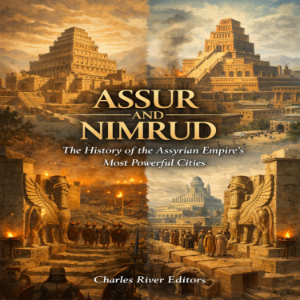
Assur and Nimrud: The History of the Assyrian Empire’s Most Powerful Cities
Charles River Editors
When the Assyrians are mentioned, images of war and brutality are among the first that come to mind, despite the fact that their culture prospered for nearly 2,000 years.
Like a number of ancient individuals and empires in that region, the negative perception of ancient Assyrian culture was passed down through Biblical accounts, and regardless of the accuracy of the Bible’s depiction of certain events, the Assyrians clearly played the role of adversary for the Israelites. Indeed, Assyria (Biblical Shinar) and the Assyrian people played an important role in many books of the Old Testament and are first mentioned in the book of Genesis: “And the beginning of his kingdom was Babel and Erech, and Akkad, and Calneh, in the land of Shinar. Out of that land went forth Assur and built Nineveh and the city Rehoboth and Kallah.”
A historical survey of ancient Assyrian culture reveals that although they were the supreme warriors of their time, they were also excellent merchants, diplomats, and highly literate people who recorded their history and religious rituals and ideology in great detail. The Assyrians, like their other neighbors in Mesopotamia, were literate and developed their own dialect of the Akkadian language that they used to write tens of thousands of documents in the cuneiform script. Furthermore, the Assyrians prospered for so long that their culture is often broken down by historians into the “Old”, “Middle”, and “Neo” Assyrian periods, even though the Assyrians themselves viewed their history as a long succession of rulers from an archaic period until the collapse of the neo-Assyrian Empire in the 7th century B.C. In fact, the current divisions have been made by modern scholars based on linguistic changes, not on political dynasties.
Even as war played such a central role in Assyrian society, they were also active and prosperous traders, and trade was an essential part of Assur’s growth from its earliest stages.
Duration - 2h 28m.
Author - Charles River Editors.
Narrator - Michelle Humphries.
Published Date - Tuesday, 27 January 2026.
Copyright - © 2026 Charles River Editors ©.
Location:
United States
Description:
When the Assyrians are mentioned, images of war and brutality are among the first that come to mind, despite the fact that their culture prospered for nearly 2,000 years. Like a number of ancient individuals and empires in that region, the negative perception of ancient Assyrian culture was passed down through Biblical accounts, and regardless of the accuracy of the Bible’s depiction of certain events, the Assyrians clearly played the role of adversary for the Israelites. Indeed, Assyria (Biblical Shinar) and the Assyrian people played an important role in many books of the Old Testament and are first mentioned in the book of Genesis: “And the beginning of his kingdom was Babel and Erech, and Akkad, and Calneh, in the land of Shinar. Out of that land went forth Assur and built Nineveh and the city Rehoboth and Kallah.” A historical survey of ancient Assyrian culture reveals that although they were the supreme warriors of their time, they were also excellent merchants, diplomats, and highly literate people who recorded their history and religious rituals and ideology in great detail. The Assyrians, like their other neighbors in Mesopotamia, were literate and developed their own dialect of the Akkadian language that they used to write tens of thousands of documents in the cuneiform script. Furthermore, the Assyrians prospered for so long that their culture is often broken down by historians into the “Old”, “Middle”, and “Neo” Assyrian periods, even though the Assyrians themselves viewed their history as a long succession of rulers from an archaic period until the collapse of the neo-Assyrian Empire in the 7th century B.C. In fact, the current divisions have been made by modern scholars based on linguistic changes, not on political dynasties. Even as war played such a central role in Assyrian society, they were also active and prosperous traders, and trade was an essential part of Assur’s growth from its earliest stages. Duration - 2h 28m. Author - Charles River Editors. Narrator - Michelle Humphries. Published Date - Tuesday, 27 January 2026. Copyright - © 2026 Charles River Editors ©.
Language:
English
Opening Credits
Duration:00:00:10
Introduction
Duration:00:05:13
Geography
Duration:00:06:24
The Sumerian and Akkadian Origins of Assur
Duration:00:04:49
The Pantheon of Northern Mesopotamia
Duration:00:04:02
The Early City
Duration:00:06:07
The Old Assyrian Period
Duration:00:11:23
The Middle Assyrian Period
Duration:00:10:59
The Neo-Assyrian Period
Duration:00:30:18
Designing a New Capital
Duration:00:21:47
The Northwest Palace at Nimrud
Duration:00:19:50
The Decline of the Neo-Assyrians
Duration:00:09:55
The Rediscovery of Assur and Nimrud
Duration:00:17:18
Ending Credits
Duration:00:00:09