
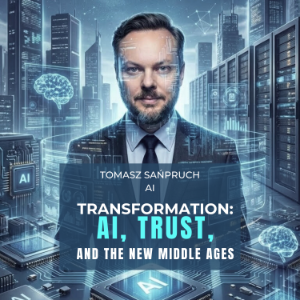
Transformation: AI, Trust, and the New Middle Ages
Tomasz Sańpruch
This audiobook is narrated by a digital voice.
Transformation is a clear-eyed exploration of a world in which artificial intelligence has moved beyond being a helpful tool and has become a full executor of work, decisions, and communication. Written at the moment when this shift quietly becomes irreversible, the book examines how generative AI is reshaping labor, authorship, power, and trust—often faster than our institutions and social narratives can adapt.
The book itself reflects the transformation it describes. Sańpruch does not position himself as a traditional author, but as a prompter—initiating meaning while AI shapes structure and language. This ambiguity of authorship mirrors a broader reality in which responsibility and agency are increasingly shared between humans and machines. What happens to work, careers, and social order when AI replaces entire processes rather than individual tasks?
Drawing on economic data, organizational research, and real-world examples from knowledge-intensive sectors, Transformation challenges comforting assumptions about “new jobs” and gradual change. It shows how productivity gains fail to translate into mass employment, how career paths are eroding, and why societies may be drifting toward a new “Middle Ages” marked by concentrated power, fragmented truth, and the growing scarcity—and value—of human trust.
This is not a manifesto for or against AI. It is a sober attempt to understand the present moment, in which work, media, and authority are being redefined in real time. This is not a book about the future—it is a book about the present, before it slips completely out of reach.
Duration - 5h 52m.
Author - Tomasz Sańpruch.
Narrator - Digital Voice Harry E.
Published Date - Friday, 02 January 2026.
Copyright - © 2040 STEO TOMASZ SANPRUCH ©.
Location:
United States
Networks:
Tomasz Sańpruch
Digital Voice Harry E
STEO Tomasz Sańpruch
English Audiobooks
INAudio Audiobooks
Description:
This audiobook is narrated by a digital voice. Transformation is a clear-eyed exploration of a world in which artificial intelligence has moved beyond being a helpful tool and has become a full executor of work, decisions, and communication. Written at the moment when this shift quietly becomes irreversible, the book examines how generative AI is reshaping labor, authorship, power, and trust—often faster than our institutions and social narratives can adapt. The book itself reflects the transformation it describes. Sańpruch does not position himself as a traditional author, but as a prompter—initiating meaning while AI shapes structure and language. This ambiguity of authorship mirrors a broader reality in which responsibility and agency are increasingly shared between humans and machines. What happens to work, careers, and social order when AI replaces entire processes rather than individual tasks? Drawing on economic data, organizational research, and real-world examples from knowledge-intensive sectors, Transformation challenges comforting assumptions about “new jobs” and gradual change. It shows how productivity gains fail to translate into mass employment, how career paths are eroding, and why societies may be drifting toward a new “Middle Ages” marked by concentrated power, fragmented truth, and the growing scarcity—and value—of human trust. This is not a manifesto for or against AI. It is a sober attempt to understand the present moment, in which work, media, and authority are being redefined in real time. This is not a book about the future—it is a book about the present, before it slips completely out of reach. Duration - 5h 52m. Author - Tomasz Sańpruch. Narrator - Digital Voice Harry E. Published Date - Friday, 02 January 2026. Copyright - © 2040 STEO TOMASZ SANPRUCH ©.
Language:
English
Title
Duration:00:00:10
Introduction
Duration:00:08:08
Methodological Note
Duration:00:00:29
Megatrend 1
Duration:00:08:01
1.1.2. Autonomous Decision-Making Systems
Duration:00:08:17
1.1.3. Scaling Compute Power and Falling Inference Costs: Economics as the “Hidden Engine” of Change
Duration:00:08:03
1.1.4. Why Human Control Is an Illusion
Duration:00:03:30
1.2. The Dynamics of Automation: Pace, Forecasts, and Historical Comparisons
Duration:00:07:16
1.3. Why AI Creates Fewer Jobs Than Earlier Technologies
Duration:00:06:39
1.3.1. The Social Consequences of the “Elevator Effect”: Inequality, Education, and Generational Frustration
Duration:00:06:01
1.3.2. Frustration as Political Fuel: Populism, Institutional Delegitimation, and the New Power of Big Tech
Duration:00:06:45
1.4. Sectoral Analysis
Duration:00:00:02
1.4.1. Marketing and Communication: A Pilot Sector for the Automation of Cognitive Work
Duration:00:05:27
1.4.1.1. Replacing Creators with AI
Duration:00:06:15
1.4.2. Public Administration: Automating the State and the Erosion of Responsibility
Duration:00:04:33
1.4.3. Finance and Banking: Algorithmic Exclusion, Scoring, and Credit as an Instrument of Power
Duration:00:10:34
1.4.4. Healthcare: Algorithmic Triage, Access to Treatment, and the Limits of Responsibility
Duration:00:05:59
1.4.5. Education: Algorithmic Teaching, Talent Selection, and the Reproduction of Inequality
Duration:00:06:21
1.4.6. IT and Software Engineering: The End of the Competency Monopoly and the Erosion of a “Privileged” Profession
Duration:00:04:56
1.5. Case Study: Communication and Marketing
Duration:00:00:04
1.5.1. The Newsroom That Is No Longer a Newsroom
Duration:00:02:19
1.5.2. The Renaissance of the “Walking Reporter”
Duration:00:06:57
1.5.3. The Wealthy Build Their Own Media: “Informational Courts of a New Middle Ages”
Duration:00:06:05
1.5.4. The Daily Battle for Human Attention
Duration:00:06:14
1.5.5. The Paradox of the AI Age: The More Information We Have, the More We Want People
Duration:00:04:58
1.6. AI as a Structural Force, Not a Tool
Duration:00:03:34
Megatrend 2
Duration:00:06:09
2.1. The Crisis of Trust in the Age of Deepfakes and Generative AIWhen evidence stops being evidence
Duration:00:06:06
2.1.1. Political Deepfakes: From Manipulation to the Delegitimization of Democracy
Duration:00:05:33
2.2. Gen Z and the Shift in Communication PreferencesData, not intuition: how a generation raised online responds to the crisis of trust
Duration:00:03:49
2.2.1. Deepfakes, Elections, and Geopolitics: When the Crisis of Trust Becomes an Instrument of Power
Duration:00:02:36
2.2.2. Geopolitics in the Age of SimulationWars Without Gunfire, Power Without Truth
Duration:00:06:05
2.3. The Renaissance of Face-to-Face Meetings
Duration:00:05:34
2.4. Authenticity as a Competitive Advantage
Duration:00:05:24
2.4.1. The Impact on Employer Branding
Duration:00:18:56
2.5.3. Anti-Deepfake PoliciesFrom Crisis Response to an Architecture of Resilience
Duration:00:05:52
Megatrend 3
Duration:00:00:59
3.1. Polarisation of the Information Market
Duration:00:06:42
3.2. Trends: Trust, Newsletters, Subscriptions
Duration:00:06:07
3.3. Disinformation and Automated Content FactoriesWhen information overproduction becomes a political and economic risk
Duration:00:23:25
3.5. The Future of the Journalistic Profession
Duration:00:07:00
Megatrend 4
Duration:00:06:08
4.1. The Concept of the “New Middle Ages”From Intellectual Metaphor to a Diagnosis of an Era (Eco, Bull, Harari, Maçães, Turchin)
Duration:00:07:11
4.2. Feudalization 2.0
Duration:00:06:03
4.3. A Plurality of Truths and Parallel Realities
Duration:00:14:26
4.5.1. Yuval Noah Harari: Power Over Narrative and Mind
Duration:00:04:27
4.5.2. Thomas Friedman: A World Too Fast for States
Duration:00:04:02
4.5.3. Bruno Maçães: The Fragmentation of Geopolitics into Parallel Worlds
Duration:00:03:46
4.5.4. Peter Turchin: Cyclical Crisis and Elite Overproduction
Duration:00:04:42
4.6. Implications for Firms and IndividualsReputation, the “Credibility Shield,” and Survival in a World of Fragmented Narratives
Duration:00:06:22
Strategic Recommendations
Duration:00:02:13
5.1. For Entrepreneurs: From Scaling to Rootedness
Duration:00:04:19
5.2. For Leaders and Managers
Duration:00:04:45
5.3. For Creative Professionals
Duration:00:04:15
5.4. For Education and Public Administration
Duration:00:04:58
5.5. For the Media
Duration:00:05:24
5.6. For Government
Duration:00:06:39
5.7. For Education and Higher Education
Duration:00:07:01
Conclusion
Duration:00:04:52
References
Duration:00:02:56